Weaving cosmic threads...
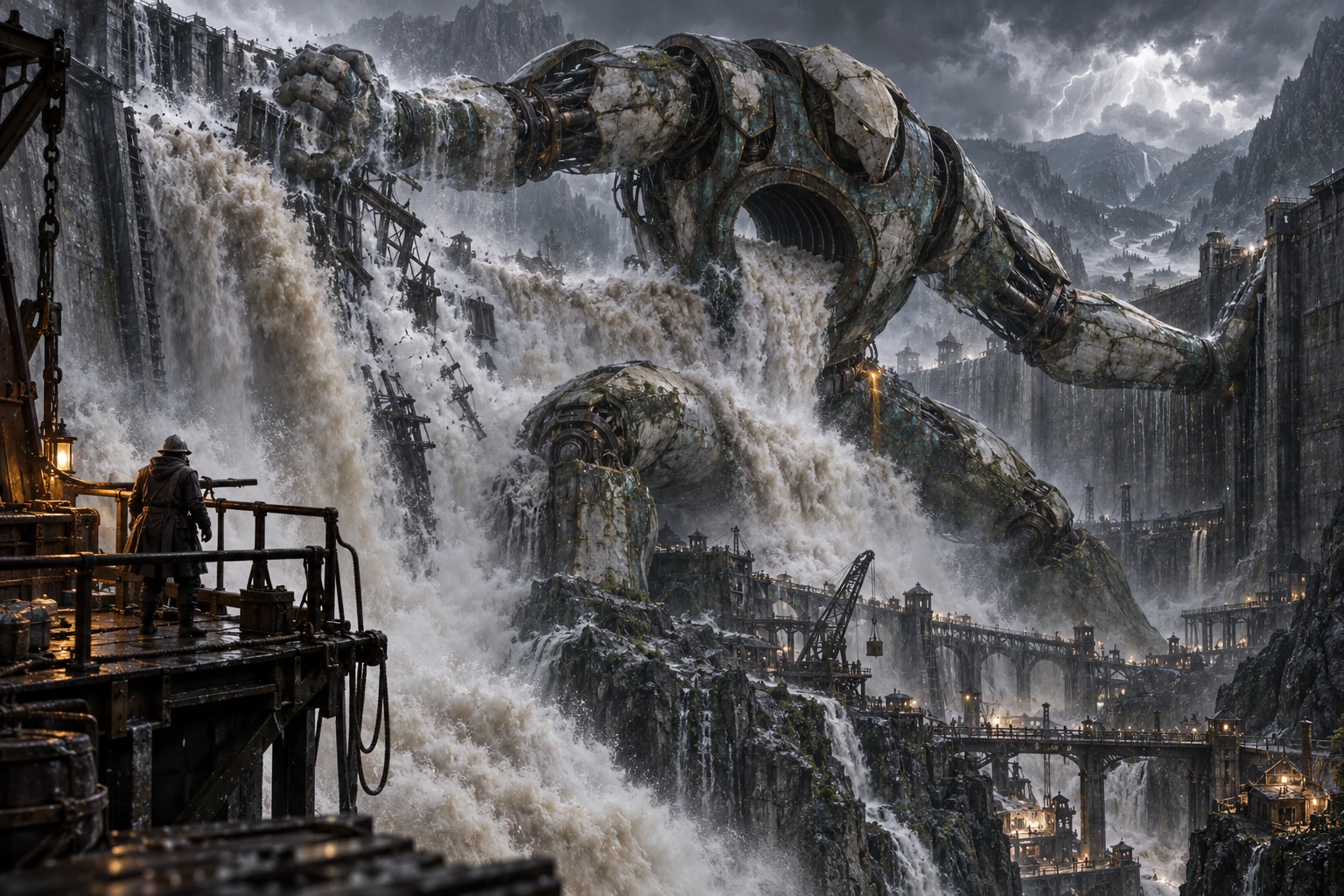
The image establishes the colossus’s weight and working conduit. Exact scale, movement and hydraulic behavior remain design proposals.
EXPERIMENTAL / Encounter concept / The Last Abutment
Orvess
An ancient flood engine still protects a boundary that leaves half its city outside. Saving it means changing what it was built to save.
The history
Orvess was commissioned to prevent a particular flood, not to govern a city. Settlements accumulated in its maintenance galleries over generations. Its original operating boundary never changed. When a contaminated pressure signal predicts the ancient disaster again, the machine prepares to seal the lower districts as sacrificial overflow chambers.
It is not angry. It is working from a definition of safety that no longer includes everyone.
The first encounter
The party hears a lockkeeper complain that the city has missed a breath. Ferry ropes tighten. Every workshop lamp leans in the same draft. Outside, a hillside rises; what looked like a mineral face is a shoulder. Orvess reaches past the party to catch a failing gate.
Objective
Restore a safe pressure sequence while keeping an evacuation route open. Combat buys access and time; damage alone does not solve the crisis.
Body and movement
Its bronze bearings polish where they move; ceramic plates retain mineral deposits from former flood levels. The chest opening is a working water conduit, not an ornamental weak spot. A narrow amber leak at the hip marks pressure loss. Its limbs move in deliberate sequences: plant, transfer load, test resistance, commit. A giant should not turn like a human wearing a large costume.
Story seeds
- An engineer’s parent signed the obsolete evacuation boundary. Write the moment the engineer finds the signature while people wait for a safe route.
- The replacement bearing belongs to another working settlement. Give its envoy a defensible reason to refuse the loan.
Authoring desk
Shape the encounter
Choose an outcome, then copy the brief into your story notes or tabletop session plan.
Current phase
The old instruction
When the lower basin reaches its first marker, Orvess sweeps intruders from the control gantries. Shoulder bearings lock audibly before each sweep. Players cross during weight transfer and use raised service recesses as cover.
Writing prompt / Session brief
Ready to copy