Weaving cosmic threads...
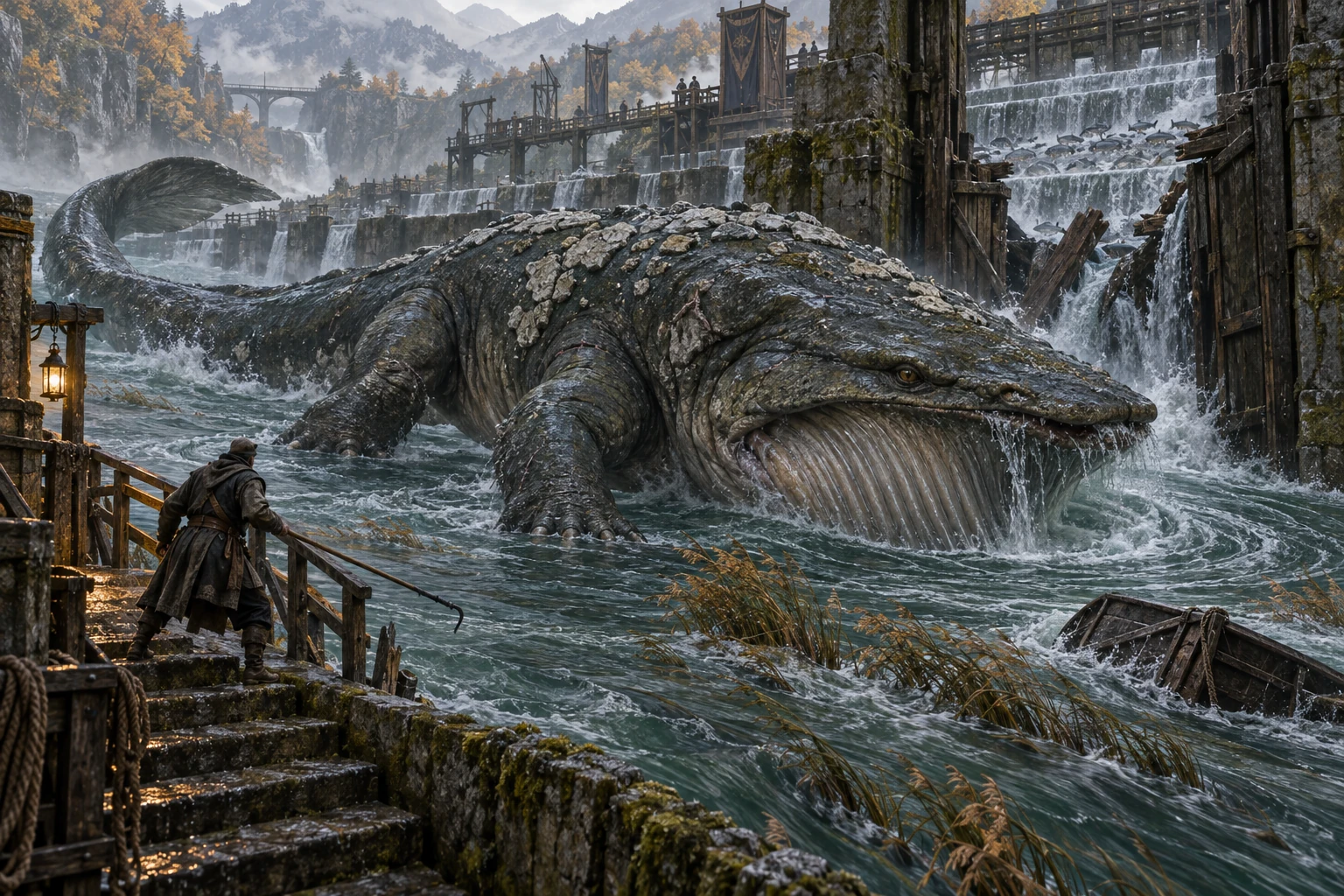
The artwork establishes mass, a suction-oriented throat and raised refuges. The far-side limbs are occluded; exact eighteen-metre scale, pressure physics and the banner designs remain unapproved design details.
EXPERIMENTAL / Encounter concept / The Undertow Maw
Tharvoss
A river predator has learned that a boat bell means trapped prey. Reopen the migration stair, survive its suction strike and take the crossing back.
The history
Tharvoss once followed the seasonal silver-run between the estuary and the mountain basins. Its digging kept deep-water refuges open through dry months. A toll order closed the fish passages while leaving the main spillways flowing. The migrating fish accumulated below the gates; the predator followed them into a place too narrow for a large animal to retreat safely.
The keepers now face an individual that attacks supply boats deliberately. A displaced animal can still be a lethal enemy. The objective is to stop those attacks and reopen the crossing, whether the party drives Tharvoss into a safe downstream channel or kills it. Removing the animal alone leaves the broken passage ready to produce the next crisis.
Local families call the old sluice bell the drowned father's supper call. That belief became practical knowledge: Tharvoss associated its sound with fish released from sorting pens. The tale is an inhabitant belief, not a new Arcanean deity. Othrek's tariff seal on the closure order links this encounter to the Brine Tribunal.
The first encounter
A sorting bell rings twice. The fish stop breaking the surface. An empty skiff slides sideways against the current; then the lower pool lifts around a broad mineral-plated back. Tharvoss ignores the nearest sword and turns toward the occupied supply boat.
Objective
Stop attacks on occupied boats, reopen the migration passage and secure a usable crossing. Driving the animal out and killing it are both valid victories with different follow-up work.
Body and movement
Four short weight-bearing limbs support a low, wide body. A pleated throat expands before the suction strike; the tail supplies turning force in deep water. On stone it plants, pulls and pauses rather than skating. Pale mineral deposits on the dorsal plates contrast with flexible dark skin.
Its hardest attacks are short bursts. After a long pull the throat collapses, the jaw rests open and the animal must draw fresh water across its respiratory surfaces. That recovery is a combat opening. The giant anatomy is fantasy extrapolation, not a claim about a real species.
Ecology and pressure
- Role: seasonal apex predator and pool excavator; it consumes silver-run fish and large river crustaceans, while small scavengers use its abandoned feeding sites.
- Dependency: connected migration channels and oxygenated refuge pools. Closed passages concentrate prey temporarily, then starve both fish and predator of viable habitat.
- Disturbance: deliberate gate closure and repeated boat feeding taught this individual a dangerous association with bells and people.
- After victory: reopen passage whichever resolution is chosen. If killed, recover the carcass in sections so decomposition does not consume the lower basin's oxygen; do not assume killing one animal restores the watershed.
Victory and mastery
Practice
Read the water before reading the monster: inward-moving foam and throat expansion announce suction. Reach the buttress recess rather than rolling blindly into the flooded lane.
Mastery
Reopen both fish passages while keeping the supply gantry intact and never using a living person as bait. Success requires positioning, patience and coordination.
Reward
The crossing reopens. Keepers teach the proposed Anchor Step technique, which lets a prepared fighter brace at marked solid cover against a sustained pull; it is a situational skill, not general knockback immunity.
Rematch
At high water one refuge is submerged and a second safe position must be created by lowering a service platform. The same cues remain readable; increased difficulty changes decisions rather than hiding information.
Story seeds
- A boat builder recognizes the bell on a wreck as one she sold to the keepers. Give her useful knowledge and a reason she has avoided the inquiry.
- Write the first safe crossing after victory from the view of a child carrying a basket too large for their hands; show which adult still refuses to board.
Authoring desk
Shape the encounter
Choose an outcome, then copy the brief into your story notes or tabletop session plan.
Current phase
The water takes a breath
Throat expansion, inward foam and two low knocks from the bell precede a sustained pull. Cross behind the planted forelimb, brace inside a buttress recess and strike the soft jaw hinge during the open-mouth recovery. Damage interrupts the next pull but does not open the gate.
Writing prompt / Session brief
Ready to copy